

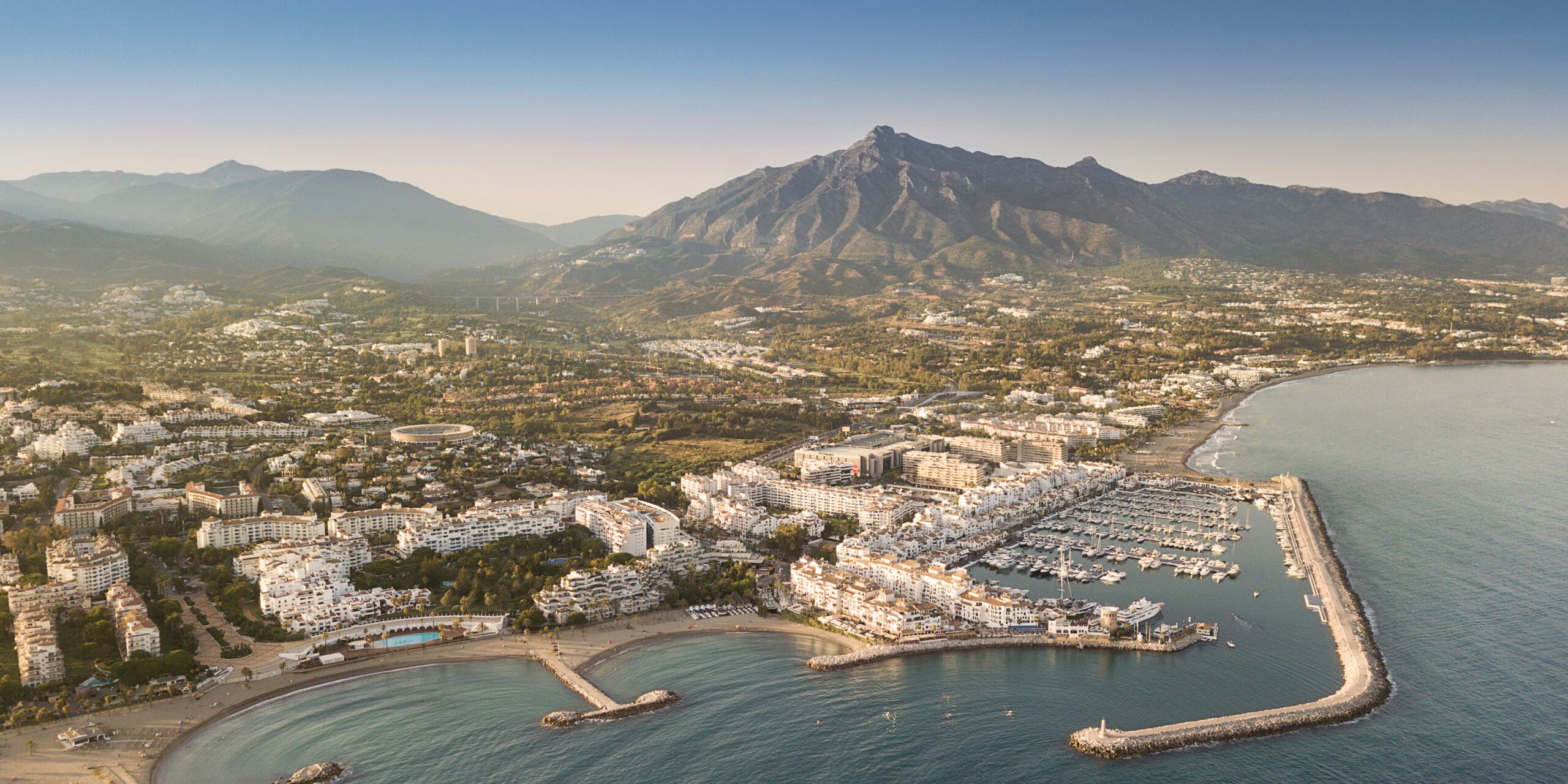
The History of Puerto Banús
How a Visionary Development Became One of Europe’s Most Valuable Luxury Assets
Puerto Banús is one of the clearest examples in Europe of how a single, well-executed real estate vision can transform an entire region. From its origins in the 1960s to its present-day status as a global luxury hub, Puerto Banús has consistently driven property values, international demand, and long-term investment appeal on the Costa del Sol.
Origins: From Fishing Village to Strategic Development (1960s–1970)
Before Puerto Banús existed, the area was a modest coastal zone near Nueva Andalucía, with limited infrastructure and little international visibility. In the 1960s, Spanish developer José Banús Masdeu identified the site’s exceptional potential: proximity to Marbella, a protected coastline, and room for a large-scale luxury marina supported by residential and commercial real estate.
Banús’ objective was clear from the outset: to create a high-end marina capable of rivaling the French Riviera, attracting international elites, yacht owners, and high-net-worth individuals. Crucially, the project was financed entirely with private capital, making Puerto Banús the first privately funded marina in Spain—a landmark moment in Spanish real estate development.
Architectural Decisions That Shaped Long-Term Value
From Modernist Concept to Timeless Design
Initial plans prepared by architect Antonio Lamela proposed a futuristic development with high-rise towers. This approach met strong opposition, notably from Alfonso de Hohenlohe, founder of the Marbella Club Hotel, who understood that overdevelopment would undermine Marbella’s long-term appeal.
A revised concept was agreed, and Banús commissioned Noldi Schreck, who designed the marina using traditional Andalusian architectural principles: low-rise buildings, white façades, human-scale proportions, and a Mediterranean village aesthetic. From a real estate perspective, this decision proved critical, ensuring architectural longevity and protecting future property values.
1970: Official Opening and Immediate Market Impact
Puerto Banús officially opened in May 1970, quickly positioning itself as an elite destination. The inaugural events attracted approximately 1,700 guests, including Reiner of Monaco, Grace Kelly, Aga Khan IV, and numerous international figures. This global exposure instantly elevated Marbella’s profile on the world stage.
From a property standpoint, the opening triggered rapid development:
Luxury apartments surrounding the marina
Villas in Nueva Andalucía
High-end commercial units and retail spaces
Puerto Banús became the anchor asset that redefined real estate values across the western Marbella area.
Early Expansion and Commercial Real Estate Growth (1970–1973)
In its early years, the marina expanded its infrastructure to accommodate luxury yachts, while a commercial center inspired by La Croisette in Cannes attracted prestigious boutiques and upscale restaurants. This integration of leisure, retail, and residential uses established Puerto Banús as a mixed-use luxury development, a model still considered best practice today.
Property demand increased rapidly, particularly for marina-front apartments and nearby villas, setting a price benchmark that continues to influence the market.
The 1973 Oil Crisis and Market Adjustment
The 1973 oil crisis marked the first major test of Puerto Banús as a real estate-driven destination. Reduced tourism and economic uncertainty impacted revenues, highlighting the vulnerability of leisure-focused developments during global downturns.
However, the project adapted. In 1978, following the re-legalisation of gambling in Spain, Banús opened the Torre del Duque Casino, incorporating restaurants, swimming pools, and a beach club. This diversification strengthened the area’s year-round appeal and supported continued property demand.
Ownership Changes and Asset Consolidation (1980–1984)
Facing financial pressure, José Banús began selling strategic assets:
In 1980, parts of Nueva Andalucía and Puerto Banús were sold to King Fahd of Saudi Arabia, leading to the development of the Benabolá complex.
In 1981, additional land holdings, including Las Brisas Golf, were sold to manage debt exposure.
José Banús passed away in 1984, and ownership later transferred within his family, marking the end of the founder-led phase of the project but not its growth.
Regulatory Shift: The 1988 Coastal Law
In 1988, Spain introduced the ‘la Ley de Costas’ (coastal law), declaring marinas and beaches public assets operated under time-based concessions, typically 30 years. From a real estate perspective, this change increased structural scarcity, as new marina developments became far more restricted.
Rather than diminishing Puerto Banús’ value, this regulation reinforced its uniqueness as a legacy asset with limited competition.
Modern Era and 50th Anniversary (1990s–2020)
Throughout the 1990s and 2000s, Puerto Banús evolved into a fully mature luxury destination, expanding marina capacity, upgrading retail offerings, and strengthening its nightlife and beach club scene.
In 2020, Puerto Banús celebrated its 50th anniversary. Although public celebrations were limited due to the global pandemic, the milestone confirmed the marina’s status as one of Europe’s most enduring luxury developments.
Puerto Banús Today: A Real Estate Legacy Asset
Today, Puerto Banús is:
A global reference for luxury marinas
A prime residential location with extremely limited supply
A magnet for international capital and lifestyle-driven buyers
Properties in and around Puerto Banús are rarely commoditised. Many transactions occur off market, particularly at the ultra-prime level, where discretion and access matter more than visibility.
Final Perspective
From a real estate viewpoint, Puerto Banús is a case study in how vision, timing, architectural restraint, and lifestyle integration can create long-term, resilient value. More than five decades after its creation, it remains one of the strongest drivers of luxury property demand in Marbella.
At LuxuryForSale.Properties, we specialise in exclusive real estate in Puerto Banús, including prime apartments, marina-front residences, villas, and off-market opportunities not available through conventional channels. We advise clients who view property not only as a home, but as a strategic, long-term asset at the very top of the market.